
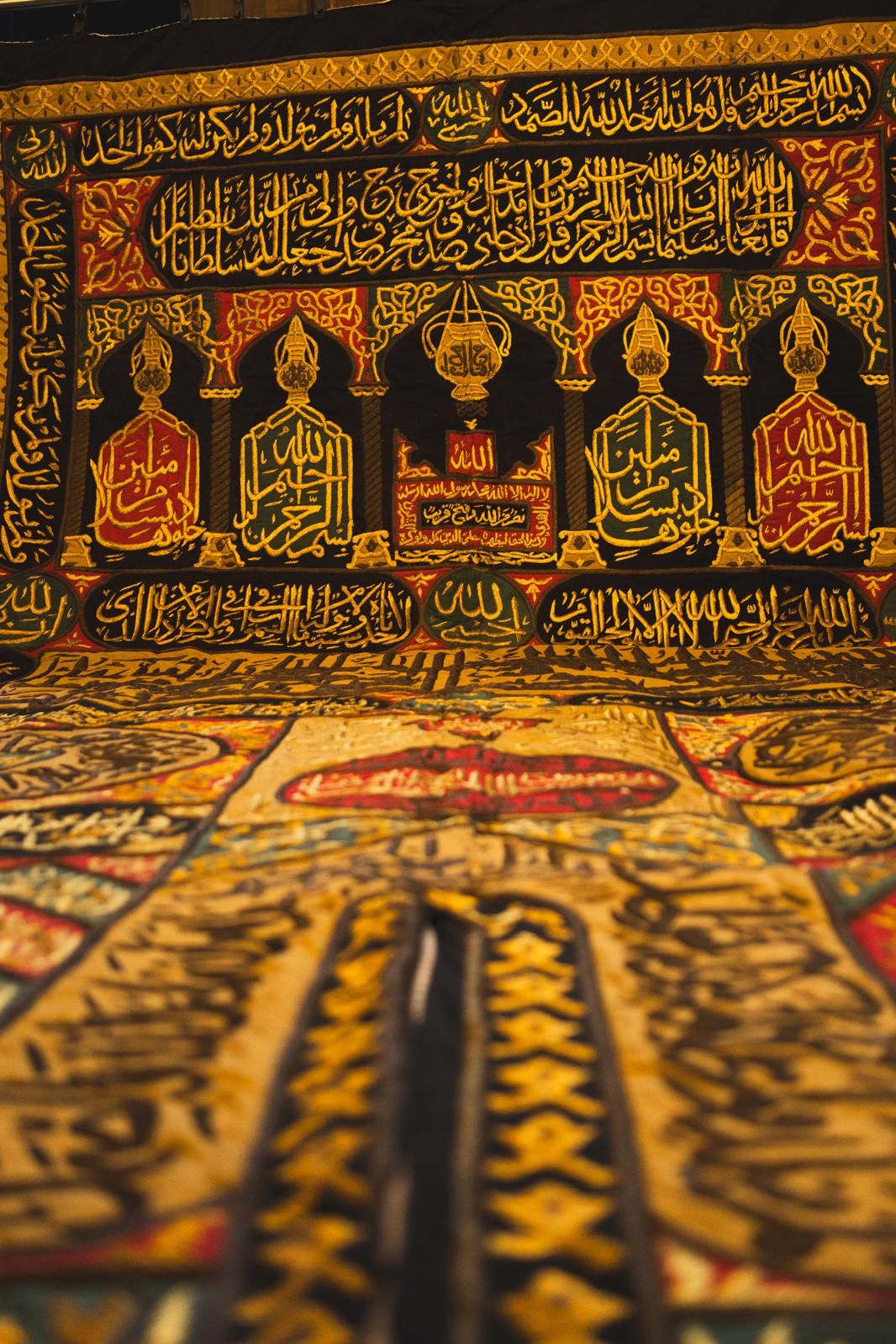
Hijri 1204 – 1790 CE
The Ottoman (Kaaba door curtain) dated 1204 Hijri is a monumental and visually commanding sacred textile, created to serve both a devotional and ceremonial purpose at the threshold of the Holy Kaaba. Large in scale and richly worked, it is densely covered with high-relief embroidery and finely executed calligraphy
The textile’s aim was to honour, protect, and visually sanctify the Kaaba’s entrance, marking it as the most revered point of approach. The craftsmanship is unmistakably Ottoman, combining precision, symmetry, and reverence: Qur’anic inscriptions and supplications are framed by elaborate floral and geometric compositions, including stylised tulip motifs, a signature symbol of Ottoman aesthetics associated with divine beauty and order
The embroidery is executed in zari work using natural metal threads—gold and silver, alongside brass and copper—layered and couched to create depth, brilliance, and durability. These metals catch and reflect light, giving the surface a luminous, almost architectural presence
The silk ground is enriched with natural colours derived from traditional sources: deep greens associated with plant-based dyes, reds commonly obtained from madder roots, and blues from indigo, all harmonised to complement the metallic embroidery rather than compete with it
The result is a textile of remarkable weight, richness, and visual power, where every stitch reflects disciplined artistry, devotional intent, and the highest standards of Ottoman sacred textile production.
Arabic
أدامه خادم الحرم المحترم
مولانا السلطان محمد بن سالم بن مصطفى بن إبراهيم بن سليمان
سنة ألفٍ ومائتين وأربع
English
Commisioned by the honoured servant of two holy sanctuaries, Molana Salim Mohammed Bin Salim Bin Mustafa Bin Ibrahim Bin Sulayman In the year 1204 Hijri
Sultan Selim III was Sultan of the Ottoman Empire from 1789 CE to 1807 CE
On the Islamic (Hijri) calendar, his rule corresponds roughly to 1203 AH – 1222 AH
He is historically known for administrative and military reform efforts, and in Ottoman records appears as a patron of arts and sacred commissions, owing to his role as Sultan and Custodian of the Two Holy Mosques
In the late Ottoman era, including the period around 1204 AH, the door cover of the Holy Kaaba was part of a long-established tradition of commissioning sacred textiles to adorn the Holy Kaaba
🧵 Materials & Production
This silk was typically high-quality and woven in established textile centres, particularly in Egypt under Ottoman supervision at the time
Embroidery was executed with metal threads—primarily silver and silver-gilt (gold-plated silver)—to emphasize Qur’anic inscriptions and decorative bands
✍️ Craftsmanship & Design
The designs on sitāras were meticulously planned by master calligraphers, who arranged Qur’anic verses, invocations, and patronage inscriptions in elegant scripts.
On the Ottoman Kaaba door cover dated 1204 Hijri, the selection and extent of Qur’anic text were notably more expansive when compared with the current Saudi-era Kiswa door.
In addition to the verses commonly associated with the Kaaba, this Ottoman sitāra included two additional complete surahs: Surah al-Falaq and Surah al-Nas, with Surah al-Nas prominently placed on the door itself, reinforcing themes of divine protection and refuge. The Ottoman door cover also incorporated four additional revered names, specifically those of the Khulafāʾ al-Rāshidūn—Abu Bakr al-Ṣiddīq, ʿUmar ibn al-Khaṭṭāb, ʿUthmān ibn ʿAffān, and ʿAlī ibn Abī Ṭālib (Raḍiya Allāhu ʿAnhum)—a feature characteristic of Ottoman religious patronage but absent from the modern Saudi Kiswah.
In contrast, the contemporary Saudi Kiswa door adopts a more restrained textual program, with fewer verses and divine names, emphasizing clarity and uniformity over density. This difference highlights a clear stylistic and devotional shift: the Ottoman door cover favoured abundance of sacred text and layered symbolism, while the modern Kiswa reflects a more minimal and standardized approach